

Best Home Repair Resources in 2025
If you own a home, one thing is certain. Something will break. Whether it's a leaky faucet, a tripped breaker, or a furnace making concerning noises, you'll eventually face a repair decision: call a contractor for a minimum of $200-500, or figure it out yourself.
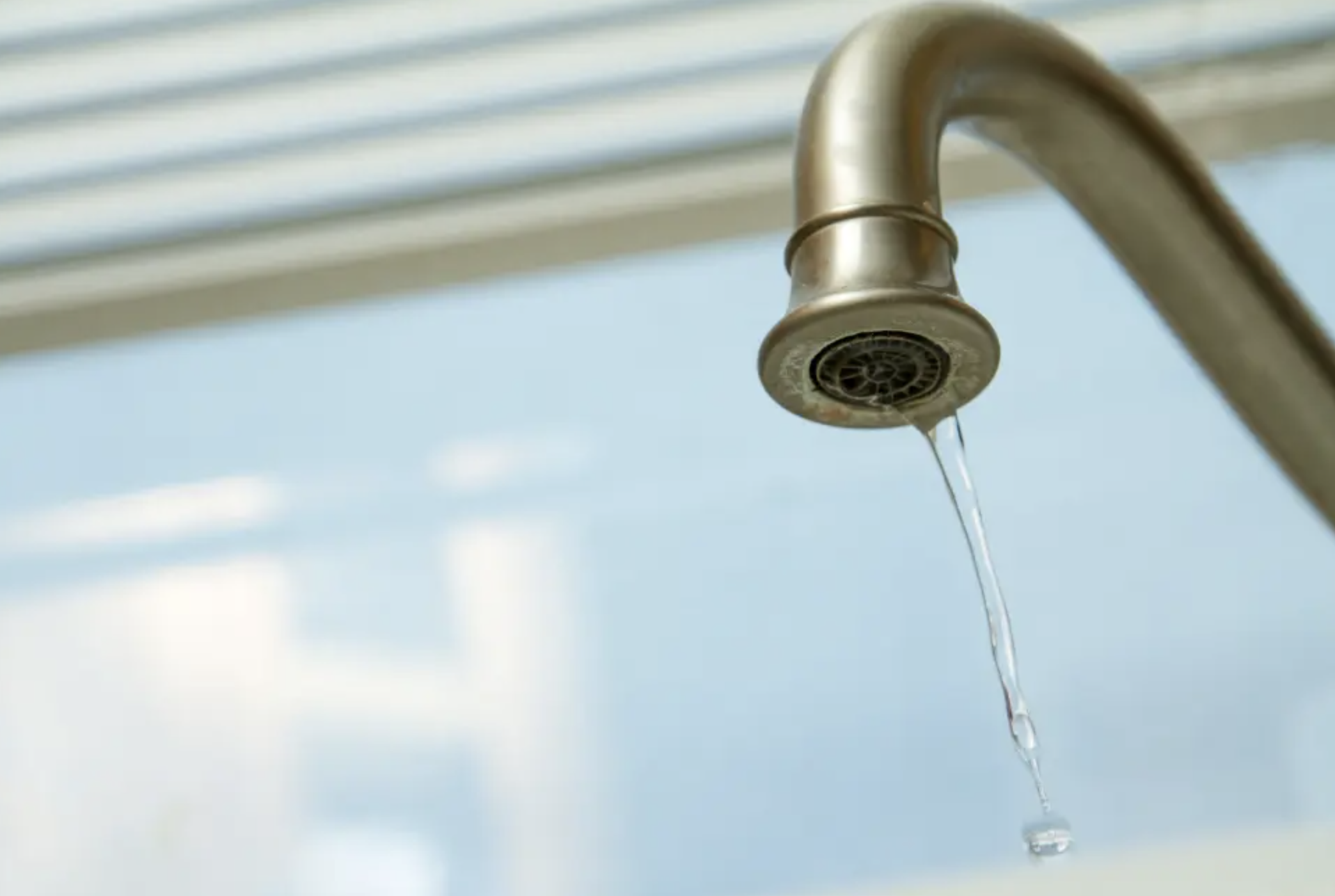
When that moment comes, having the right resource can mean the difference between a confident 30-minute fix and a frustrating afternoon of guesswork. But not all repair resources are created equal. Some give you vague advice, others require you to watch 20 minutes of video for a 5-minute fix, and a few can actually lead you down dangerous paths.
That's why we compared the best free home repair resources in 2025. We looked at what actually helps homeowners complete repairs safely and successfully.
The main aspects we reviewed:
- •Specificity: Does it give you actual part numbers and sizes, or just "get a wrench"?
- •Safety guidance: Are code advice and safety warnings included?
- •Time to answer: How long until you actually know what to do?
- •Reliability: Can you trust the advice won't make things worse?
- •Accessibility: Can you use it in the basement with no signal?
TLDR: Our Top Picks for Home Repair Help
- 1You Fixed It: AI-powered repair plans with step-by-step instructions, troubleshooting tips, specific part numbers, safety warnings, and code advice. Like having a contractor guide you through the process.
- 2YouTube: Massive library of free repair videos. Best for visual learners who want to see techniques demonstrated. Great to use alongside specific guidance.
- 3Reddit (r/HomeImprovement): Community-driven advice from 7+ million members. Responses take hours and quality varies.
- 4ChatGPT: General AI that can discuss repairs, but lacks specificity and safety guidance for home work.
- 5Family Handyman / This Old House: Trusted editorial content, but static articles that may not match your exact problem.
All Home Repair Resources at a Glance
| Resource | Response Time | Part Numbers | Safety Warnings | Code Advice | Works Offline |
|---|---|---|---|---|---|
| You Fixed It | 30-60 seconds | ||||
| YouTube | Free, on-demand | ||||
| Hours to days | |||||
| ChatGPT | Fast | ||||
| Family Handyman | Instant (if article exists) |
You Fixed It
AI-powered repair plans built for homeowners
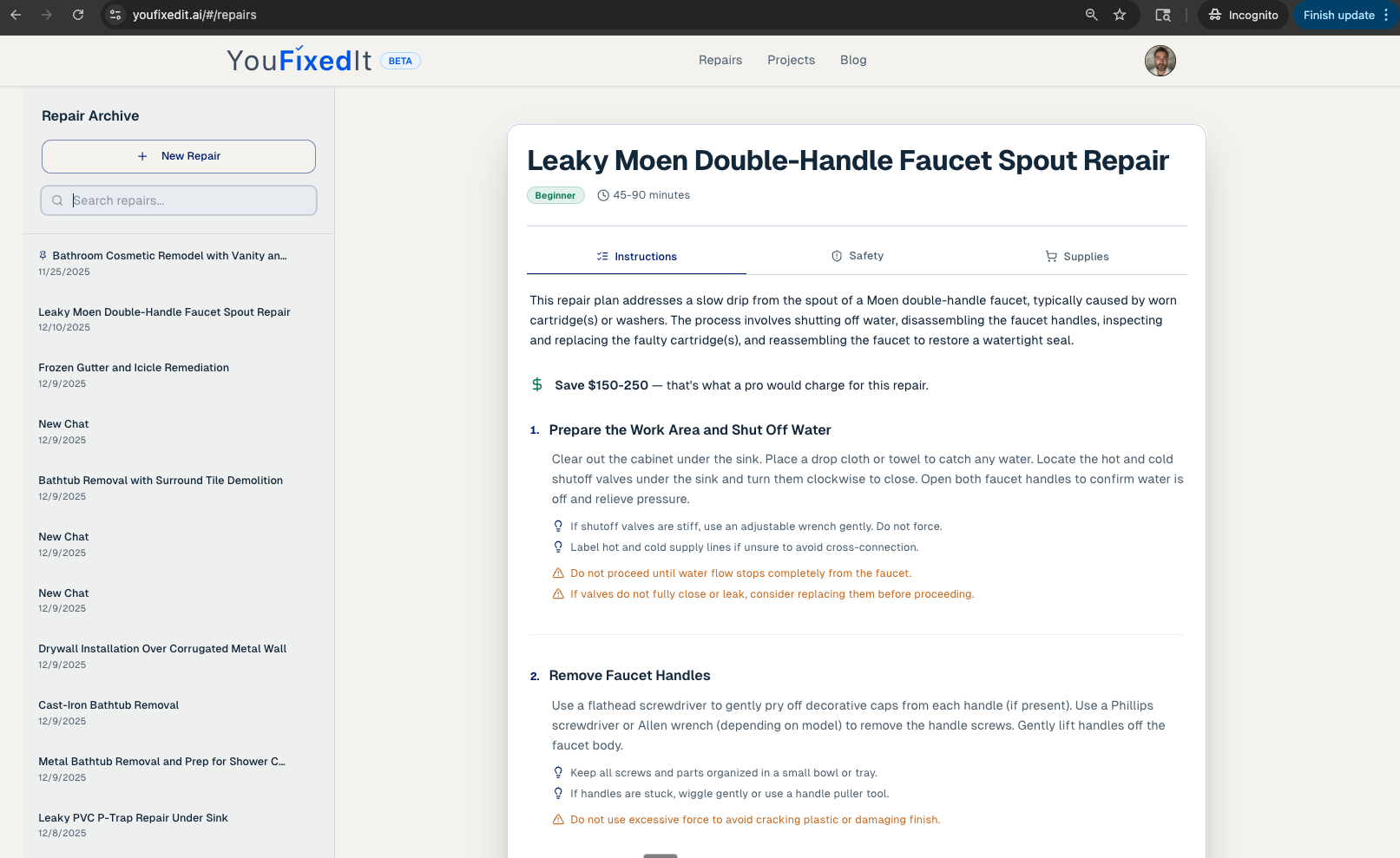
See what a real repair plan looks like for a leaky kitchen faucet
You Fixed It is an AI-powered home repair assistant that generates complete repair plans. Describe your problem or upload a photo, and you get back numbered steps, specific materials with part numbers and sizes, tool requirements, safety warnings, and local code advice. You also receive links to buy all necessary supplies.
What You Get
Specificity
This is where You Fixed It stands apart. Instead of "get a replacement cartridge," you'll see "Moen 1225 cartridge or equivalent, 1-5/16" O.D." Instead of "turn off the power," you'll see "Locate the circuit breaker panel, identify the 15A or 20A breaker labeled 'Kitchen' or 'Disposal,' and switch to OFF position. Verify power is off using a non-contact voltage tester before proceeding."
It gives you a specific supply list so you can confidently walk into the hardware store (or order online with the provided link), buy exactly what you need, and complete the repair without second-guessing yourself.
Safety and Codes
Every repair plan includes relevant safety warnings before you encounter them in the steps—not as an afterthought. Electrical work includes NEC code references. Plumbing repairs mention when permits are typically required. HVAC guidance includes when to call a licensed professional instead.
User-Friendliness
The interface works like a conversation. Type what's broken ("my garbage disposal won't turn on") or upload a photo, and you get back a complete repair plan. No account required to try it, and plans are saved automatically if you do sign up.
Offline Access
Unlike every other resource on this list, You Fixed It works offline. Your repair data syncs to your device, so when you're in the basement with no cell signal, you can still pull up your repair plan. This alone makes it uniquely practical for actual repair work.
Pricing
14-day free trial with full access to all features. After that, subscription pricing gives you unlimited repair plans. Users save $200-500 per repair they complete themselves, often paying for a year of service with a single fix.
YouTube
The world's largest video library
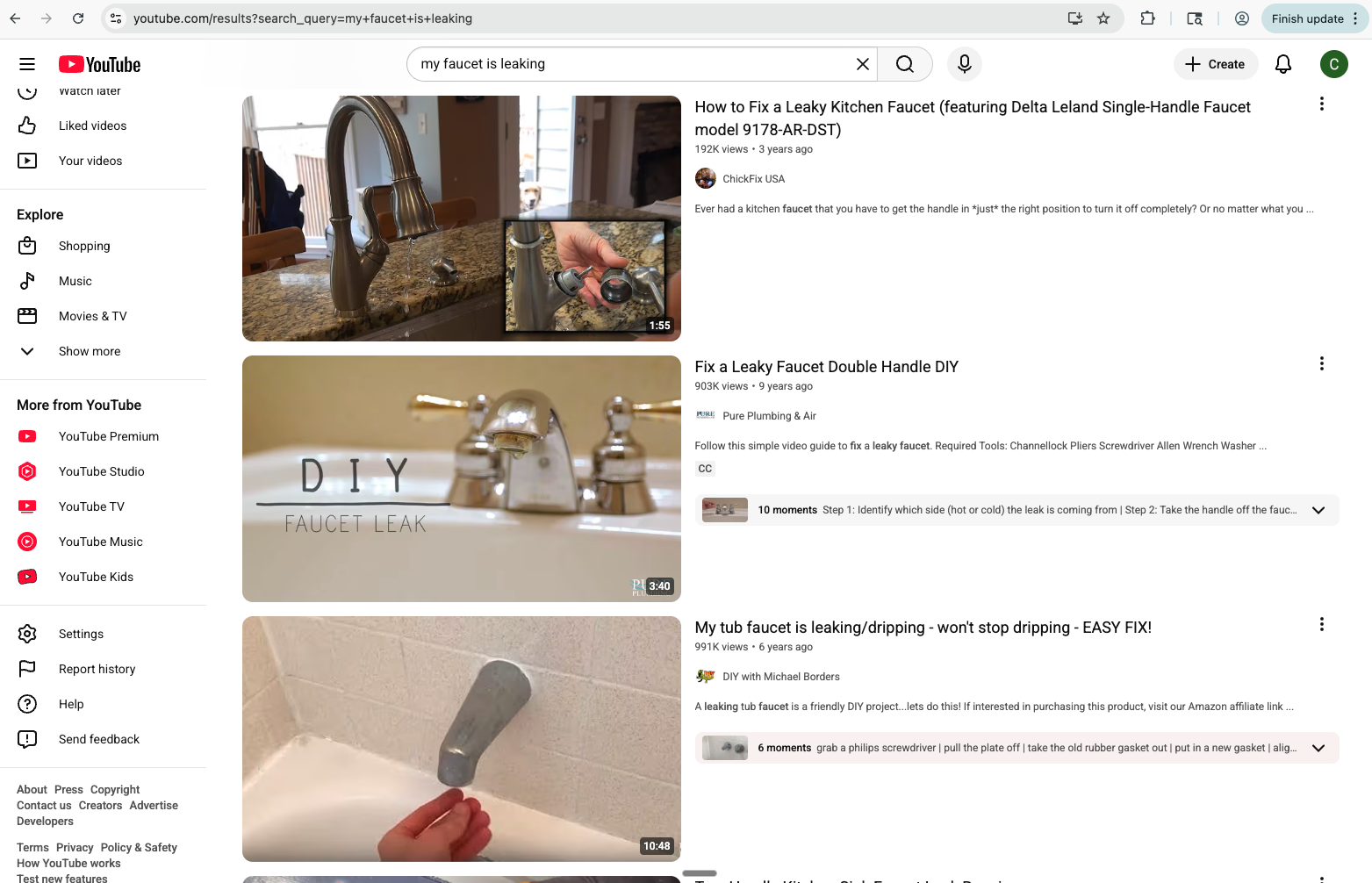
YouTube remains the most popular destination for DIY repair guidance, with thousands of channels dedicated to home improvement. From This Old House's professional productions to individual contractors sharing their expertise, there's likely a video for whatever you're trying to fix.
What You Get
Specificity
Varies by creator. Professional channels like This Old House or Home Repair Tutor provide detailed guidance with clear explanations. The best channels walk you through techniques step by step.
One thing to keep in mind: videos show one person's repair on one specific setup. Your faucet might be a different brand, your electrical panel might be wired differently. That's why pairing video demonstrations with specific guidance for your situation works well.
Safety and Codes
Some creators are careful about safety. Many are not. Building codes are almost never mentioned.
User-Friendliness
YouTube's strength is visual learning. Seeing someone perform a repair builds confidence before you start. For best results, pair videos with specific guidance so you know exactly which parts fit your setup.
Best Channels for Home Repair
We've organized the best channels by specialty so you can find the right creator for your project.
General DIY & Home Improvement
- •This Old House - Professional production, reliable advice
- •Dad, How Do I? - Rob Kenney's beginner-friendly tutorials
- •See Jane Drill - Leah Bolden's accessible tutorials for all skill levels
- •Home RenoVision DIY - Jeff Thorman's general contractor expertise
- •Ron Hazelton - Classic DIY guidance
- •Everyday Home Repairs - Practical guidance for common issues
- •Home Mender - Dustin Luby's straightforward repairs
- •The Handyman - General DIY and lawn care
- •Today's Homeowner - Chelsea Lipford Wolf's home improvement tips
- •Refresh Home Improvements - Dan & Steve Tuer's DIY projects
- •FIX IT Home Improvement Channel - General DIY solutions
- •HouseImprovements - Shannon's home repair guides
- •DIY Network - Broad range of home projects
Plumbing
- •Roger Wakefield - Licensed plumber with detailed explanations
- •Home Repair Tutor - Jeff Patterson's plumbing and tiling tutorials
- •Got2Learn - Clear plumbing instruction
- •mmplumber - Professional plumbing tips
- •The Million Dollar Plumber - Plumbing expertise and business insights
- •Steven Lavimoniere - HVAC and plumbing crossover
HVAC & Appliances
- •Word of Advice TV - HVAC and appliance repair from a licensed technician
- •DIY HVAC Guy - Dave's heating and cooling tutorials
- •Steven Lavimoniere - HVAC diagnostics and repair
Construction & Building Science
- •Matt Risinger - Building science and modern construction techniques
- •That Kilted Guy - Guy Purcella's drywall expertise
Specialty
- •Idaho Painter - Chris Berry's professional painting techniques
UK-Based Channels
- •The Home Improvements Channel UK - Phil & Brad's general DIY
- •Plumber Parts UK - James Lawrence's plumbing tutorials
Best Used For
YouTube excels at learning concepts and seeing techniques demonstrated. It's especially valuable when paired with specific guidance that tells you which exact parts you need. Watch a video to see the technique, use specific guidance to know you've got the right parts.
Reddit (r/HomeImprovement & r/DIY)
Community-powered repair advice
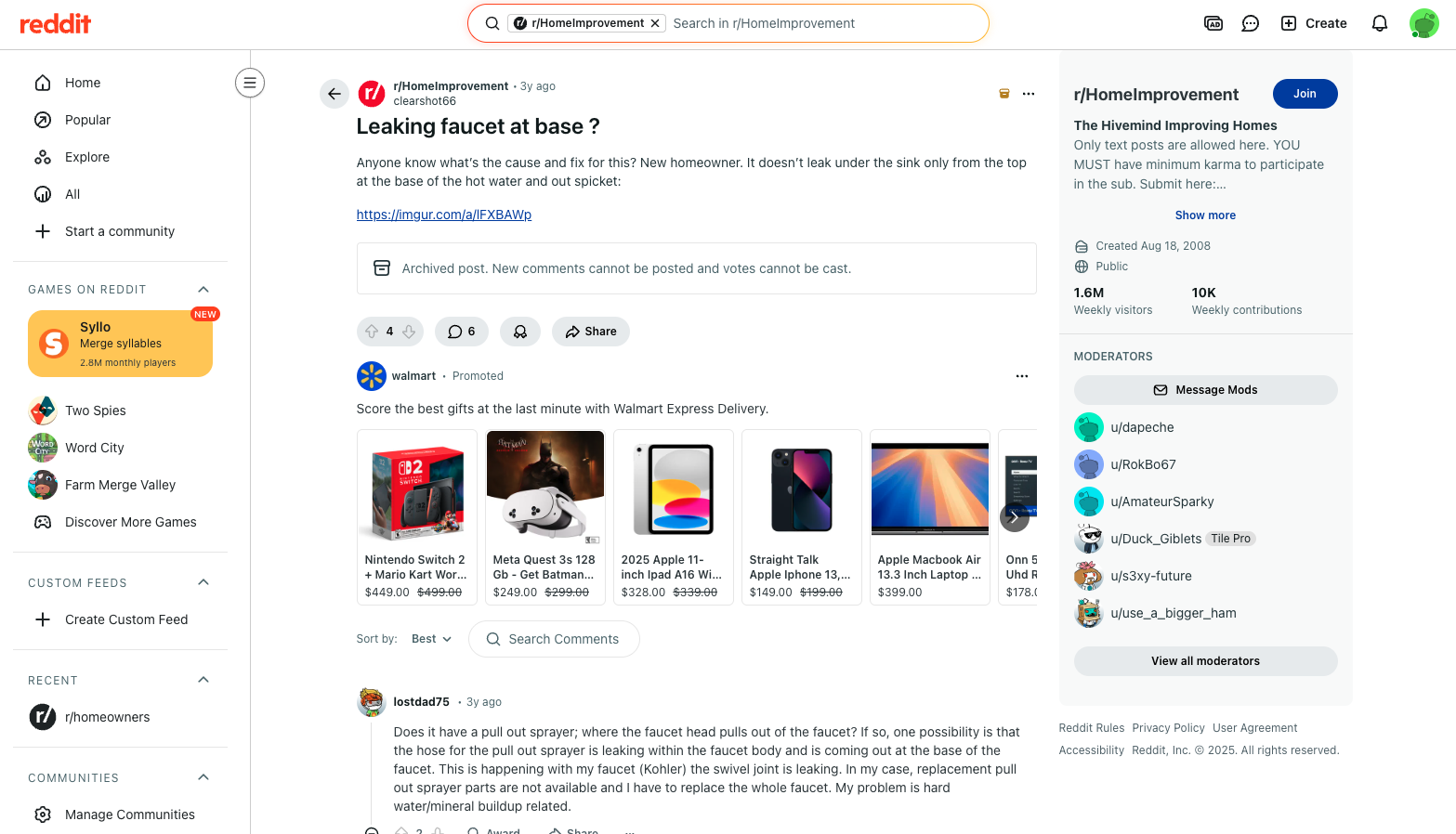
Reddit's home improvement communities are massive—r/HomeImprovement alone has over 7 million members. These are real homeowners and professionals sharing their experiences, answering questions, and providing the kind of crowdsourced knowledge that can be incredibly valuable.
What You Get
Specificity
Community responses range from incredibly detailed to dangerously vague. The upvote system helps surface better answers, and moderators actively flag questionable advice. Licensed professionals often contribute with real expertise.
But you're asking strangers who can't see your actual situation. They're guessing at your setup, your skill level, and your local requirements.
Safety and Codes
One of Reddit's strengths: the community tends to be conservative about safety. You'll often see responses like "for electrical work beyond changing outlets, you really should call a licensed electrician" or "that sounds like a job that needs a permit."
The weakness: this advice comes after you've already posted and waited for responses. It's not built into the guidance from the start.
User-Friendliness
Reddit works best when you have time. Post your question with photos, wait for responses, ask follow-ups, and eventually piece together a plan. The search function can surface past threads about similar problems, but Reddit's search is notoriously poor at finding relevant content.
Best Subreddits for Home Repair
- •r/HomeImprovement - 7M+ members, general home repair
- •r/DIY - Broader DIY projects including home improvement
- •r/Plumbing - Plumbing-specific questions
- •r/askanelectrician - Electrical questions from pros
- •r/HVAC - Heating and cooling systems
- •r/Appliances - Major appliance issues
Limitations
The time delay is the killer. When your toilet is overflowing or your basement is flooding, you don't have hours to wait for Reddit responses. And the advice, however well-intentioned, can't see what you're actually working with.
General AI Assistants like ChatGPT
Conversational AI for general questions
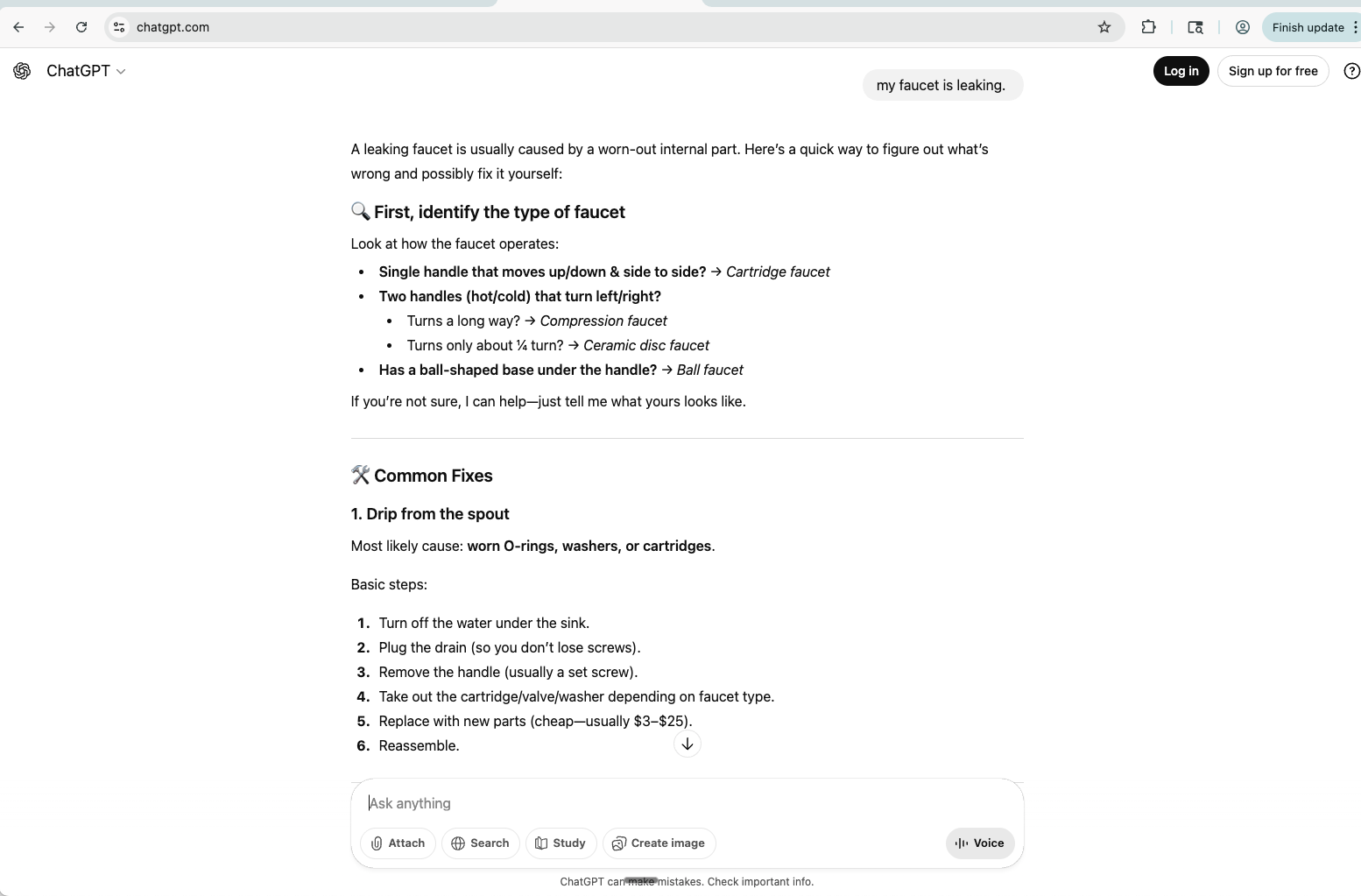
ChatGPT and similar AI assistants can discuss home repairs and provide general guidance. They're knowledgeable about a wide range of topics and can answer questions conversationally.
What You Get
Specificity
Here's where general AI falls short for home repair. ChatGPT will tell you to "replace the washer" but not which washer, what size, or what brand fits your faucet model. It will mention "turn off the breaker" but can gloss over safety advice.
Ask about a Moen kitchen faucet, and you might get generic advice that applies to faucets generally. You won't get "the Moen 1225 cartridge is your likely culprit, you'll need a cartridge puller tool, and while you're in there, replace the O-rings too."
Safety and Codes
General AI provides basic safety reminders. Turn off power, turn off water, but lacks the depth of knowledge needed for home repair safety.
One study found that ChatGPT's home repair advice, while generally sound, lacked the specificity that prevents mistakes. "Check the drain hose" is less useful than "the drain hose on Kenmore top-loaders often kinks at the standpipe connection; disconnect at both ends and check for blockages at the 18-inch mark."
User-Friendliness
Conversational interface is intuitive. You can ask follow-up questions and get immediate responses. This is convenient, but convenience doesn't help if the advice isn't specific enough to act on.
Limitations
General AI wasn't built for home repair. It can discuss the topic intelligently, but it won't give you part numbers, won't know building codes, and won't warn you about the specific gotchas that catch DIYers on particular repairs.
Family Handyman, This Old House, and DoItYourself.com
Trusted editorial content
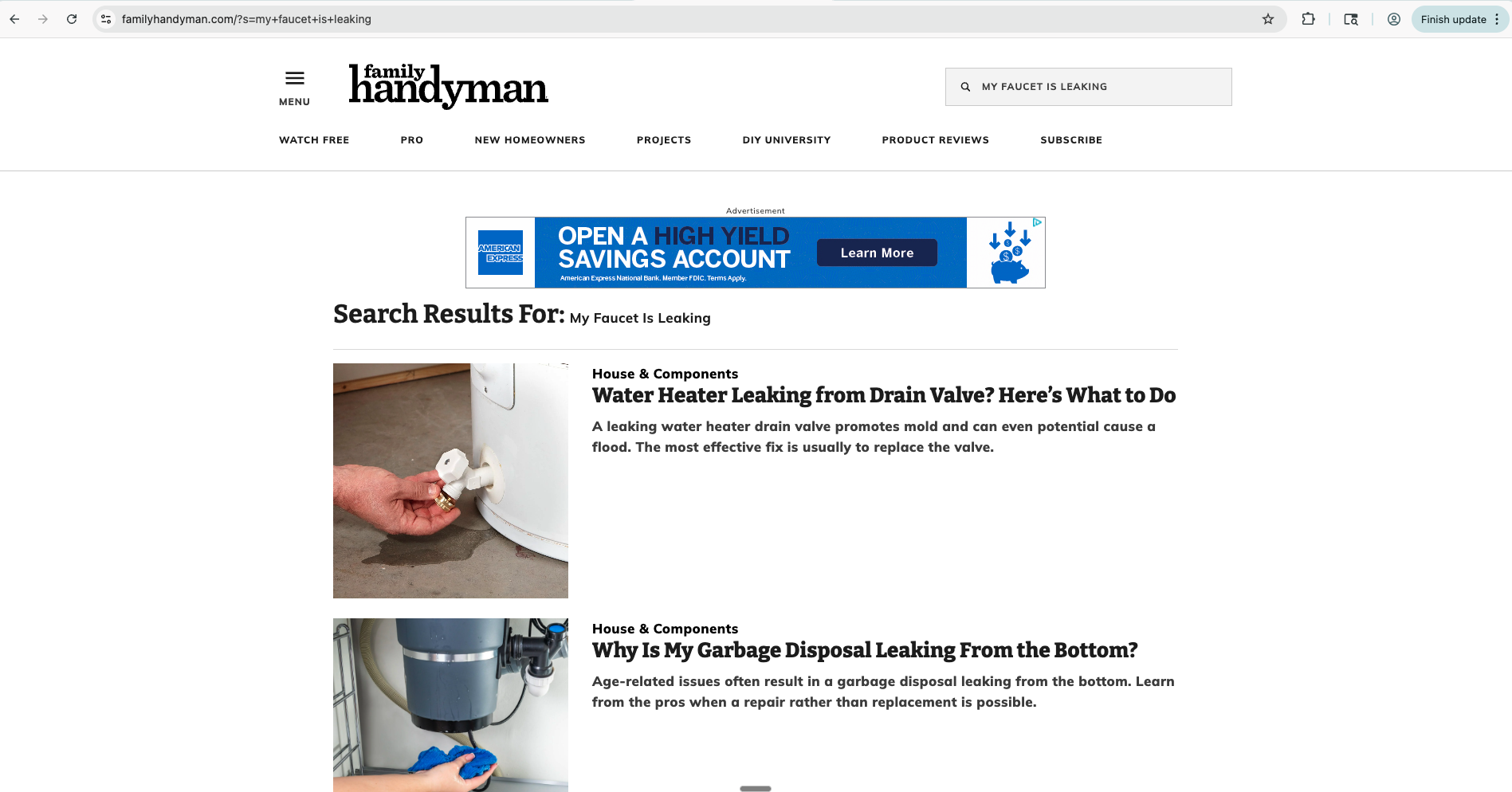
Editorial home improvement sites like Family Handyman, This Old House, and DoItYourself.com have decades of trusted content. These are professionally written articles with expert contributors and editorial oversight.
What You Get
Specificity
Professional editorial content tends to be well-researched and accurate. Family Handyman articles often include specific product recommendations and detailed step-by-step photos.
The limitation: articles are written for broad audiences. The "how to fix a leaky faucet" article covers general principles, not your specific faucet model. You'll often need to adapt generic instructions to your actual situation.
Safety and Codes
Reputable sites include safety warnings and usually mention when permits or professional help is advisable. This Old House in particular emphasizes proper technique and safety practices.
User-Friendliness
You need to find the right article for your problem, which might not exist or might be buried under SEO-optimized content. These sites are also heavily ad-supported, which can make navigation frustrating.
Limitations
Static content can't adapt to your specific situation. If your problem doesn't match an existing article exactly, you're piecing together guidance from multiple sources and hoping you understand how they apply to your case.
Which Home Repair Resource Should You Use?
The best resource depends on your situation:
Use You Fixed It when:
- • You need specific part numbers and sizes
- • You want a complete supply list with links to buy online
- • You want safety warnings and code advice built in
- • You're working somewhere without reliable internet
- • You want a complete repair plan, not fragments to piece together
- • You want basic troubleshooting advice
- • You need to do a complicated repair that you are unsure of
- • You need guidance for plumbing, electrical, HVAC, or construction
- • You're not sure if something is DIY-able or needs a pro
Use YouTube when:
- • You want to see a technique demonstrated visually
- • You have time to find and watch the right video
- • You're learning concepts before attempting a repair
- • Visual demonstration is more helpful than written instructions
Use Reddit when:
- • You have time to wait for responses
- • Your question is unusual or complex
- • You want multiple perspectives on an approach
- • You're not sure if something is DIY-able or needs a pro
Use ChatGPT when:
- • You want general information about a repair topic
- • You're troubleshooting and want to discuss possibilities
- • You need conceptual understanding, not specific instructions
Use Editorial Sites when:
- • You want trusted, professionally vetted content
- • Your problem matches a common scenario they've covered
- • You're researching before deciding on an approach
The Bottom Line
Home repair resources have improved dramatically. You no longer have to guess what's wrong, hope YouTube has your answer, or wait days for a contractor's availability.
The key is matching the resource to your need. For general learning, YouTube and editorial sites remain valuable. For community wisdom, Reddit's there when you have time. For quick conceptual answers, ChatGPT can help you understand what you're dealing with.
For actual home repairs, the plumbing, electrical, HVAC, and construction work that makes up most homeowner maintenance, you want specificity. You want to know exactly what parts to buy, exactly what tools you'll need, exactly what safety precautions to take, and exactly what steps to take.
That's what You Fixed It was built for. Not generic advice that might apply to your situation, but specific guidance that makes you more capable to do the job right.
This article was written by You Fixed It, an AI-powered home repair assistant. We believe homeowners deserve quality guidance without contractor-sized bills. Our goal is to help you fix things yourself, safely, correctly, and with confidence.
Frequently Asked Questions
Q: Is DIY home repair actually safe?
A: Many repairs are well within DIY capability. Replacing faucet cartridges, unclogging drains, fixing running toilets, replacing outlets and switches. The key is knowing your limits. Legitimate repair resources will tell you when something requires a licensed professional.
Q: How do I know when to call a pro?
A: Good repair guidance tells you this upfront. General rules: anything involving the main electrical panel, gas lines, structural elements, or your main water supply is usually better left to professionals. Permit requirements in your area also indicate when licensed work is expected.
Q: Can AI really give reliable repair advice?
A: AI trained specifically on repair knowledge can be highly reliable. The key differentiator is specificity. General AI gives general answers, while repair-focused AI can provide the specific part numbers, tool requirements, and safety considerations that generic responses lack.
Q: What if I make a mistake?
A: This is why specificity matters. Detailed instructions with safety warnings before each risky step help prevent mistakes. Good repair guidance also tells you what to check before proceeding, reducing the chance of errors.
Q: How much can I actually save doing repairs myself?
A: The average service call for a plumber or electrician runs $200-500 for simple repairs. A garbage disposal replacement might cost $400 from a plumber vs. $50 in parts doing it yourself. Over a year of homeownership, DIY capability can easily save $1,000's.